
Phosphorus Testing
Analysis of Phosphorus with Spectrophotometry:
The appropriate size solid sample is weighed and inserted into a micro bomb. The bomb is then charged with the appropriate reagents to completely digest the phosphorus compound. The apparatus is clamped shut and heated in a flame for 60 seconds. The contents are washed out and diluted.
The resulting mix is cooled and filtered. After a treatment, a complex forms. This has a unique golden-yellow color. The more phosphorus present the deeper the color.
This determination follows Beer’s Law. It is important for the analyst to initially know, theoretically, how much phosphorus to expect. This is critical in selecting the proper sample size. Heavy amounts of SiO2 in the sample present an interference. Several other metals can also interfere.
Note that not ALL metals are interfering elements. Triphenylphosphate and tripenylphosphine are chemical standards commonly used in calibration for this determination.
The preceding is a brief description of our techniques used in phosphorus determinations.
Please phone or e-mail us if you have specific questions about Phosphorus analysis in regard to your sample.
What is Phosphorus?
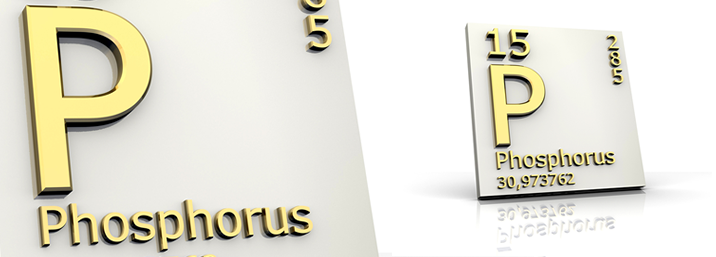
Atomic weight 30.97, Atomic Number 15, Melting Point 44.20 C, Boiling Point 280.50 C.
Phosphorus, (from the Greek language phôs meaning “light”, and phoros meaning “bearer”), is the chemical element in the periodic table that has the symbol P and atomic number 15. A multivalent nonmetal of the nitrogen group, phosphorus is commonly found in inorganic phosphate rocks and in all living cells.
Phosphorus exists in several allotropes, most commonly white, red and black. White phosphorus (P4) contains only four atoms, resulting in very high ring strain and instability. White phosphorus glows in the dark and is highly explosive as well as toxic.
 Red phosphorus has a network form which reduces strain and gives greater stability. Red phosphorous does not catch fire in air at temperatures below 240°C whereas white phosphorus ignites at about 40°C. Black phosphorus is amorphous and is the least reactive allotrope.
Due to its high reactivity, phosphorus is never found as a free element in nature. It emits a faint glow upon exposure to oxygen (hence its Greek derivation and the Latin meaning ‘morning star’) and is an essential element for living organisms.
The most important commercial use of phosphorus-based chemicals is the production of fertilizers. They are also widely used in explosives, nerve agents, friction matches, fireworks, pesticides, toothpaste, and detergents.
Relevant sites for Phosphorus:
Chemical Reactivity
Organophosphorus compounds having phosphorus oxidation states ranging from –3 to +5, as shown in the following table, are well known (some simple inorganic …
Phosphotyrosine – Columbia Encyclopedia article about Phosphotyrosine
tyrosine (tī`rəsēn),organic compound, one of the 20 amino acids amino acid (əmē`nō), any one of a class of simpleorganic compoundscontaining carbon, …
inorganic phosphate- Columbia Encyclopedia article about …
Columbia Encyclopedia® article aboutinorganic phosphate.inorganic phosphate. …Inorganic compounds by element · InorganicCrystal Structure Database …