Iodine Testing
Iodine Determination via Schoniger Combustion:
The solid sample is weighed into ashless paper and inserted into custom made Platinum stopper. The stopper is fitted it a flask that is charged with the appropriate absorbants and oxygen. On combustion the Iodine present is trapped in several forms…free iodine and Iodate.
The gasses are absorbed on the liquids. The resulting liquid is treated with various reactants to convert all remaining Iodine to the form of Iodate. The resulting liquid is then titrated with a standardized solution of Sodium thiosulfate
A standard starch titration yields a color change of black to clear at the endpoint. Other halogens do not seem to interfere in the determination. Selenium does seem to show some interference.
The most common standard for this determination is Potassium Bi-Iodate and Para-Iodo-Benzoic Acid from the NIST. There are others that may be used on occasion.
The preceding is a brief description of our techniques used in the determination of iodine.
This can be a time consuming and labor intensive determination, therefore: we cannot usually guarantee a 24 hour “rush” turnaround for this work.
What is Iodine?
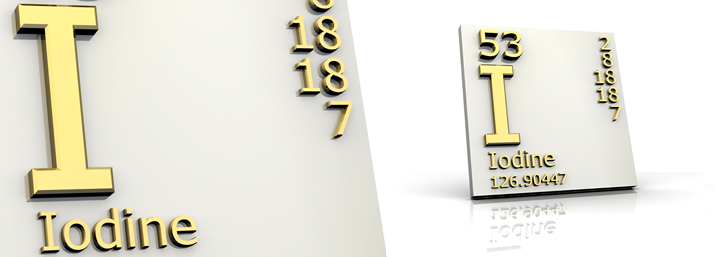
Atomic weight 126.90, Atomic Number 53, Melting Point 113.70 C, Boiling Point 184.30 C.
Iodine (from the Greek word Iodes, meaning “violet”), is a chemical element in the periodic table that has the symbol I and atomic number 53. Chemically, iodine is the least reactive of the halogens, and the most electropositive halogen after astatine. Iodine is primarily used in medicine, photography and dyes. It is required in trace amounts by most living organisms.
As with all other halogens (members of Group VII in the Periodic Table), iodine forms diatomic molecules, and hence, has the molecular formula of I2.
Iodine is a dark-gray/purple-black solid that sublimates at standard temperatures into a purple-pink gas that has an irritating odor. This halogen forms compounds with many elements, but is less active than the other members of its Group VII (halogens) and has some metallic-like properties.
Iodine dissolves easily in chloroform, carbon tetrachloride, or carbon disulphide to form purple solutions (It is only slightly soluble in water, giving a yellow solution). The deep blue color of starch-iodine complexes is produced only by the free element.
Many students who have seen the classroom demonstration where iodine crystals are gently heated in a test tube come away with the impression that liquid iodine cannot exist at atmospheric pressure. This misconception arises because sublimation occurs without the intermediacy of liquid.
The truth is that if iodine crystals are heated carefully to their melting point of 113.7 °C, the crystals will fuse into a liquid, which will be present under a dense blanket of the vapor.
Relevant sites for Iodine:
Chemistry and the Aquarium
These results are indicative of total iodine (iodide + iodate + organic iodine) … Dissolved organic iodine in marine waters: Determination, occurrence and…