Fluorine Testing
Analysis of Fluorine using the ISE:
For fluorine testing, the appropriate size solid sample is weighed and inserted into a micro bomb. The bomb is then charged with the appropriate reagents to completely digest the fluorine compound. The apparatus is clamped shut and heated in a flame for 60 seconds. The contents are washed out and diluted.
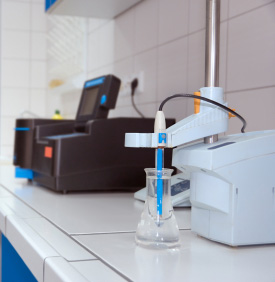 The readings taken with the electrode are compared against readings from two dilutions of NaF standard. Thus a standardization check is done every time fluorine is determined.
With air-sensitive and/ or liquid samples digestion is done after sealing the sample in a Sn Capsule. Fluorine is a complex and labor intensive determination.
It is important to note that the sample does not come into contact with glass through out the process. Aluminum and -OH are the only know interference. Strong base is circumvented in the dilution process.
With some modifications this determination is carried out according to the method of Ma and Rittner (“Modern Organic Elemental Analysis” Marcel Dekker Inc. New York, NY 1979)
Please phone or e-mail us if you have specific questions about Fluorine analysis in regard to your sample.
What is Fluorine?
Atomic weight 18.99, Atomic Number 9, Melting Point -219.62 C, Boiling Point -188.15 C.
Fluorine (from L. fluere, meaning “to flow”), is the chemical element in the periodic table that has the symbol F and atomic number 9. Atomic fluorine is univalent and is the most chemically reactive and electronegative of all the elements.
In its pure form, it is a poisonous, pale, yellow-green gas, with chemical formula F2. Like other halogens, molecular fluorine is highly dangerous; it causes severe chemical burns on contact with skin.
Fluorine’s relatively large electronegativity and small atomic radius makes it have some interesting bonding characteristics.
Pure fluorine (F2, since fluorine is diatomic) is a corrosive pale yellow gas that is a powerful oxidizing agent. It is the most reactive and electronegative of all the elements, and readily forms compounds with most other elements.
Fluorine even combines with the noble gases, krypton, xenon, and radon. Even in dark, cool conditions, fluorine reacts explosively with hydrogen. It is so reactive that glass, metals, and even water, as well as other substances, burn with a bright flame in a jet of fluorine gas.
It is far too reactive to be found in elemental form and has such an affinity for most elements, including silicon, that it can neither be prepared nor be kept in glass vessels. In moist air it reacts with water to form the equally dangerous hydrofluoric acid.
In aqueous solution, fluorine commonly occurs as the fluoride ion F-. Other forms are fluoro-complexes, such as [FeF4]-, or H2F+.
Fluorides are compounds that combine fluorine with some positively charged counterpart. They often consist of ions. Fluorine compounds with metals are among the most stable of salts.
Relevant sites for Fluorine:
Process for preparing fluorine – containing organic compounds…
A method for the preparation of a fluorine – containing organic compound which comprises reacting a sulphonyl halide of the formula: RfSO.sub.2 X where Rf…
Electronegativity – polar bonds in organic compounds
Halogen: a member of group VII of the Periodic Table – fluorine, chlorine, bromine and iodine. Halide: a compound of one of these – e.g. hydrogen chloride…