Bromine Testing
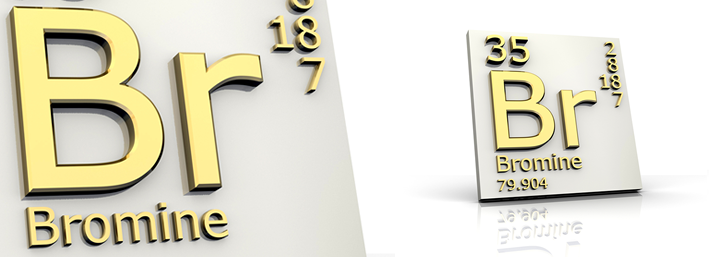
Bromine determination via Schoniger Combustion
The solid sample is weighed into ashless paper and inserted into custom made
Platinum stopper. The stopper is fitted it a separatory funnel that is charged
with the appropriate reagents. The resulting liquid is removed via washing with i-ProH.
The liquid is titrated using 2,7’-Dichlorofluorescein as an indicator.
The calibration for bromine determinations is established using para-bromobenzoic acid (39.75% Br). Note that larger levels of Bromine require less sample while lower levels of (expected) Bromine require a larger sample.
Interference’s here include Cl and Iodine. Br & Cl can be done together in the same sample IF a clear ratio exists between the two. We must be given that ratio in a molecular formula. Eg. we cannot analyze Br when a small Cl impurity is present.
The preceding is a short synopsis of the technique used for the Bromine determination. Please contact us if there are any questions.
What is Bromine?
Atomic weight 79.904, Atomic Number 35, Melting Point 7.2 C, Boiling Point 58.78 C.
Bromine is a heavy, volatile, corrosive, reddish-brown, non-metallic liquid element, having a highly irritating vapor. It is used in producing gasoline antiknock mixtures, fumigants, dyes, and photographic chemicals.
Bromine is the only liquid nonmetallic element at room temperature and one of five elements on the period table that are liquid at or close to room temperature. The pure chemical element has the physical form of a diatomic molecule, Br2.
It is a heavy, mobile, reddish-brown liquid, that evaporates easily at standard temperature and pressures in a red vapor (its color resembles nitrogen dioxide) that has a strong disagreeable odor resembling that of chlorine. A halogen, bromine resembles chlorine chemically but is less active.
It is more active than iodine, however. Bromine is slightly soluble in water, and highly soluble in carbon disulfide, aliphatic alcohols (such as methanol), and acetic acid. It bonds easily with many elements and has a strong bleaching action.
Bromine is highly reactive and is a powerful oxidizing agent in the presence of water. It reacts vigorously with amines, alkenes and phenols as well as aliphatic and aromatic hydrocarbons, ketones and acids (these are brominated by either addition or substitution reactions).
With many of the metals and elements, anhydrous bromine is less reactive than wet bromine; however, dry bromine reacts vigorously with aluminium, titanium, mercury as well as alkaline earth metals and alkaline metals.
Due to its contribution to ozone depletion in Earth’s atmosphere, bromine has been evaluated to have an ozone depletion potential of 60 when compared to chlorine.
Relevant sites for Bromine:
A comprehensive look at the history, properties, and uses.
Electrophilic Addition – unsymmetrical alkenes and bromine
Facts and mechanism for the electrophilic addition reaction between unsymmetrical alkenes like propene and bromine (and the other halogens)
Chemistry : Periodic Table : bromine : index
This WebElements page contains a thorough index for the Bromine.